Keeping score in card games: Tarneeb, Baloot, Belote and more
Most card games are scored the same way: points per hand, played to a target. The usual targets, and a score sheet for teams on your phone.
Keeping score in card games: Tarneeb, Baloot, Belote and more
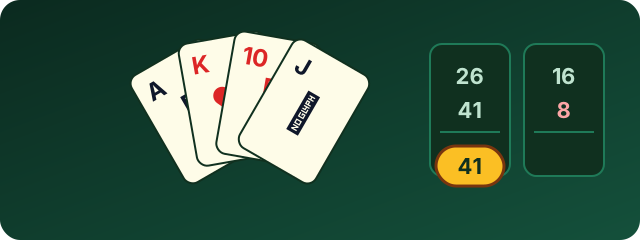
Card games look very different at the table, but many are scored the same way: every hand gives points to a player or a team, the totals grow, and the first side to reach an agreed number wins. Across the Arab world the paper sheet is famous for its two columns, "لنا" and "لهم", us and them. This article lists common targets and shows how to keep the score on your phone instead of a napkin.
One way of counting, many games
| Game | Played by | Who wins | Usual target |
|---|---|---|---|
| Tarneeb | 4 players in 2 teams | most points | 31 or 41 |
| Baloot | 4 players in 2 teams | most points | 152 |
| Belote | 4 players in 2 teams | most points | 501 or 1001, by region |
| Batak | 4 players, alone or in pairs | most points | set hands or a target |
| Pişti | 2 players, or 4 in pairs | most points | often 101 or 151 |
| Classic okey | 4 players | fewest points | 20 |
The targets are what most tables use; many groups have their own. Settle the number before the first deal, because it decides how long the evening is.
Negative hands
Games with bids can take points away. In Tarneeb, a team that fails its bid loses that many points; in Batak, a player who misses the bid goes minus. A good score sheet has to handle a total below zero without anyone doing the subtraction in their head.
Keeping score with okey101.app
- Create the game: on the home page choose "Points". Enter the players, or one name per team, for example "لنا" and "لهم".
- Set the target: under Options keep "Most points win" (or choose "Fewest points win" for classic okey) and set the target, for example 41 or 152.
- After every hand: type each side's points. For a negative hand tap ±, since phone keypads have no minus key.
- The end: as soon as a side reaches the target, the game stops and names the winner.
Everyone at the table can follow the score with the PIN on their own phone, and the final table can go to the group as an image. The game in detail: score sheet for points games.
Why not just paper?
Paper works until someone asks what the total was three hands ago, or whether the last minus was counted. A shared score that everyone sees, with every hand listed, settles it at once, and it never gets lost between two tea glasses.